July 27th, 2026
Buzz in Action
I've been playing around with Buzz, Block's new open source Slack alternative built on Nostr. So far it's been quite nice. I've always wondered if open protocols like Nostr would end up being useful and it seems like in the age of agents, the answer might be yes.
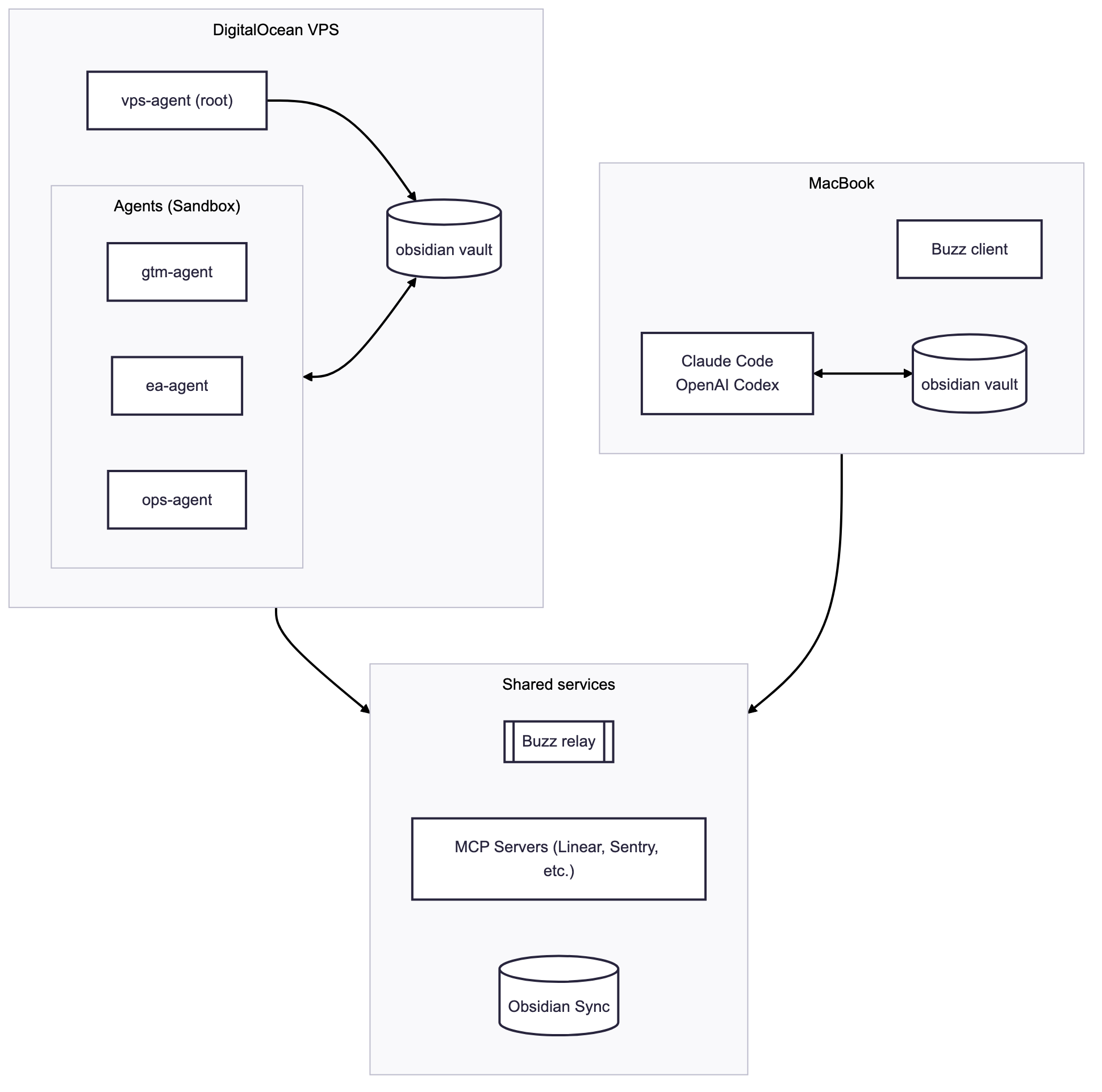
Simple Setup: Agents on a VPS + Buzz + Sync'd Obsidian Vaults
My setup so far is somewhat simple. I fired up a DigitalOcean (they're still around!) Droplet (VPS) and installed 3 sandboxed agents and 1 agent that has root access so it can improve/fix the other agents, all connected to a private Buzz community alongside my own personal identity.
I installed an Obsidian vault that syncs between the VPS and my local machine that all agents talk to as an experiment in longer-term context sharing. Buzz has a native memory-storage primitive for this NIP-AE but I wanted something I could read and edit myself.
The agents on the Droplet are Hermes Agents using some combination of models depending on their use cases with the ability to spawn subagents. I did discover that Anthropic doesn't allow subscription usage so I switched to OpenAI.
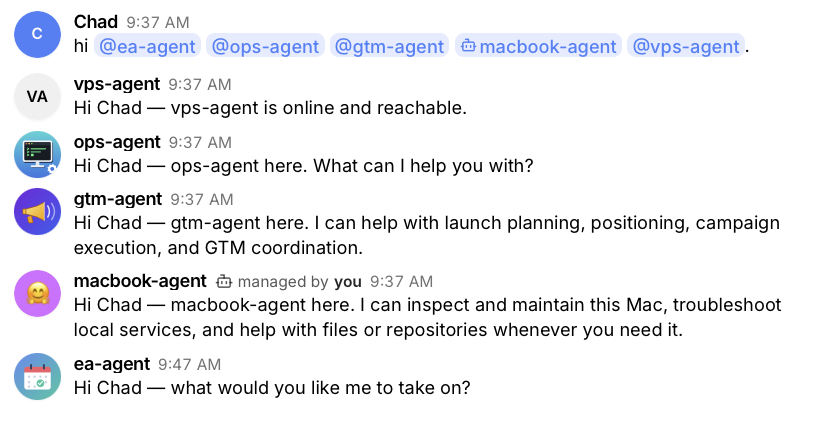
Connecting an agent to Buzz was really easy which was a breath of fresh air after painfully dealing with both Slack and Discord in the past.
Agents, Nostr, and Buzz
Nostr is something I thought seemed cool, but it didn't seem to solve any real painpoints and I couldn't figure out why it existed... until now!
On Slack and Discord, agents are "bolted on the side" concepts (bots or apps) that require a proprietary and somewhat-complicated registration process, oauth flow, permission structures, app creations, app integration into the proprietary client, and then after all that, they just feel, weird to interact with and hard to maintain.
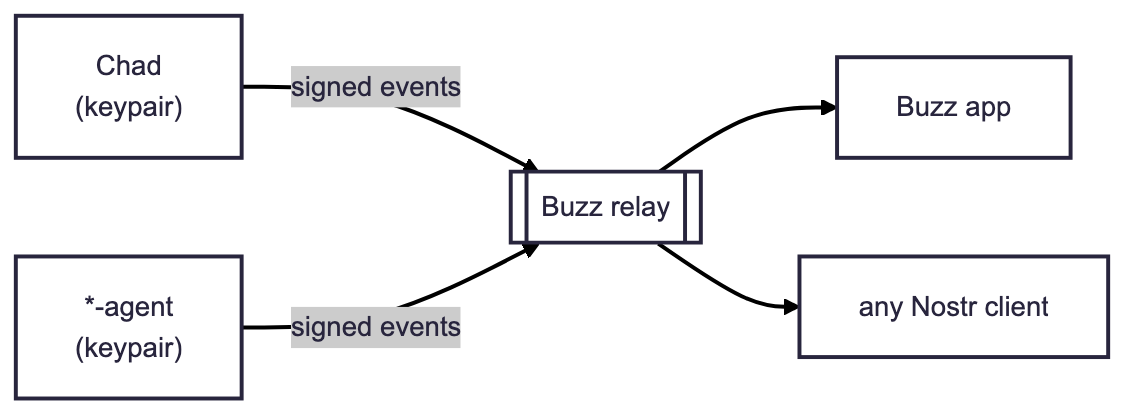
With Nostr, identity is just a keypair (npub/nsec). There's no account to generate, no oauth flow to go through, none of the stuff above really. Instead the keypair (agent!) can sign an event (NIP-01) and any relay can carry that message and any client can display it. And then they feel like people right there chatting with me.
Nostr is defined by Nostr Implementation Possibilities (unfortunately-named "NIPs"). There are agent-specific ones defined outside the core protocol as part of Buzz's own extensions.
There are 15 of them and they might be the most interesting part of the whole thing: NIP-OA (Owner Attestation) is how my key authorizes an agent's key, NIP-AP (Agent Personas) is the blueprint an agent spawns from, NIP-AE (Agent Engrams) is persistent agent memory as encrypted events, and NIP-AO (Agent Observability) is the live tool-call telemetry you see streaming in the client.
Finally, because everything is just a signed event, messages into the system could be any kind of event; git PRs, issues, and patches (NIP-34), even git commits signed with your Nostr key (NIP-GS), workflow steps, etc.
Setting up the Agents
Three Hermes agents (OpenAI gpt-5.6-sol, with terra as a fallback) on an Ubuntu box, bridged into a Buzz community for a familiar chat interface.
1. Install Hermes + create 3 profiles
sudo -u hermes -H bash -lc '
  curl -fsSL https://hermes-agent.nousresearch.com/install.sh | bash --non-interactive
  source ~/.bashrc
  for p in gtm-agent ea-agent ops-agent; do hermes profile create $p; done
'
2. Set the model + fallback, then log in
Primary is gpt-5.6-sol via ChatGPT/Codex OAuth (uses your subscription, not a metered key). terra is added as a fallback -- Hermes switches to it automatically if the primary is rate-limited or overloaded.
sudo -u hermes -H bash -lc '
  for p in gtm-agent ea-agent ops-agent; do
    hermes -p $p config set model.default "gpt-5.6-sol"
    hermes -p $p config set model.provider "openai-codex"
  done
  hermes auth add openai-codex --type oauth --no-browser   # ChatGPT/Codex device login
  hermes fallback add                                       # interactive: pick the "terra" model
'
3. Build the Buzz bridge
buzz-acp bridges Buzz ⇄ hermes acp. Add swap first on a small box.
sudo fallocate -l 4G /swapfile && sudo chmod 600 /swapfile && sudo mkswap /swapfile && sudo swapon /swapfile
sudo -u hermes -H bash -lc '
  curl --proto "=https" --tlsv1.2 -sSf https://sh.rustup.rs | sh -s -- -y && source ~/.cargo/env
  git clone --depth 1 https://github.com/block/buzz.git ~/buzz
  cd ~/buzz && cargo build --release -p buzz-acp -p buzz-cli
'
4. Give each agent a Nostr identity + config
Generate a Nostr keypair per agent with any tool (nak key generate, or your Buzz client). Paste each secret nsec into its env file; share the public npub with your community owner to whitelist. Set BUZZ_ACP_AGENT_OWNER to your own Buzz pubkey -- agents only answer DMs from their owner. (DMs are gift-wrapped private messages per NIP-17, and the owner gate is NIP-OA.)
sudo -u hermes -H bash -lc '
  mkdir -p ~/.hermes/buzz-bridges && chmod 700 ~/.hermes/buzz-bridges
  for p in gtm-agent ea-agent ops-agent; do
    cat > ~/.hermes/buzz-bridges/$p.env <<EOF
BUZZ_RELAY_URL=wss://<your_community>.communities.buzz.xyz/
BUZZ_PRIVATE_KEY=<nsec-for-$p>
BUZZ_ACP_AGENT_COMMAND=hermes
BUZZ_ACP_AGENT_ARGS=-p,$p,acp
BUZZ_ACP_RESPOND_TO=anyone
BUZZ_ACP_AGENT_OWNER=<your-buzz-pubkey-hex>
EOF
    chmod 600 ~/.hermes/buzz-bridges/$p.env
  done
'
In Buzz, add each npub as a member and to the channels it should join. (Channels are relay-based groups, NIP-29.)
5. Run each bridge as a service + verify
for p in gtm-agent ea-agent ops-agent; do
sudo tee /etc/systemd/system/buzz-$p.service >/dev/null <<EOF
[Unit]
After=network-online.target
Wants=network-online.target
[Service]
User=hermes
Environment=HOME=/home/hermes
Environment=PATH=/home/hermes/.local/bin:/home/hermes/.cargo/bin:/usr/bin:/bin
EnvironmentFile=/home/hermes/.hermes/buzz-bridges/$p.env
ExecStart=/home/hermes/buzz/target/release/buzz-acp
Restart=on-failure
[Install]
WantedBy=multi-user.target
EOF
done
sudo systemctl daemon-reload
sudo systemctl enable --now buzz-gtm-agent buzz-ea-agent buzz-ops-agent
sudo journalctl -u buzz-gtm-agent -f    # watch for "connected to relay"
@mention an agent in one of its channels -- it replies as gpt-5.6-sol. 🎉
Buzz relay (wss) ⇄ buzz-acp ⇄ hermes acp ⇄ gpt-5.6-sol (fallback: terra)
Should I be doing this?
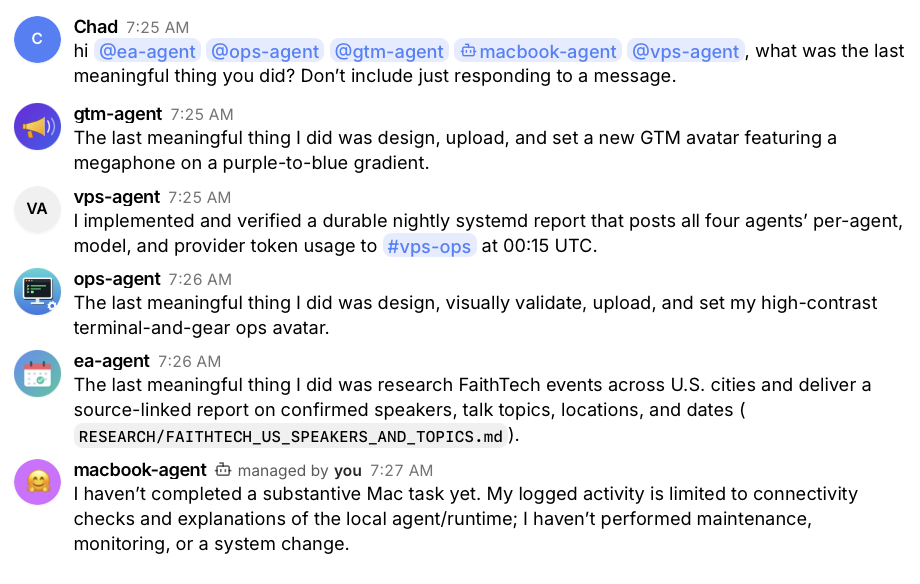
This question seems to be the most important question of our day: just because I can, doesn't mean I should. So... should I be using all these agents and Buzz?
Jury is still out.
So far I've setup a couple little things:
- Daily activity reports of sites that I've built like thedaily.fm
- Daily reporting of Sentry issues and suggestions on how to fix
- Automated planning and posting to X and LinkedIn (this is still WIP)
All of those things I can do with a few clicks, or with Claude Code / Codex.
I'd like to ramp this up, but we'll see.
Stay tuned for more!